
Arizona’s controversial Empowerment Scholarship Account program might no longer be on the ballot, but it’s playing out in the race for the state’s top public education official.
Read more Joe Arpaio ally given waiver to remain in key role at sheriff’s office
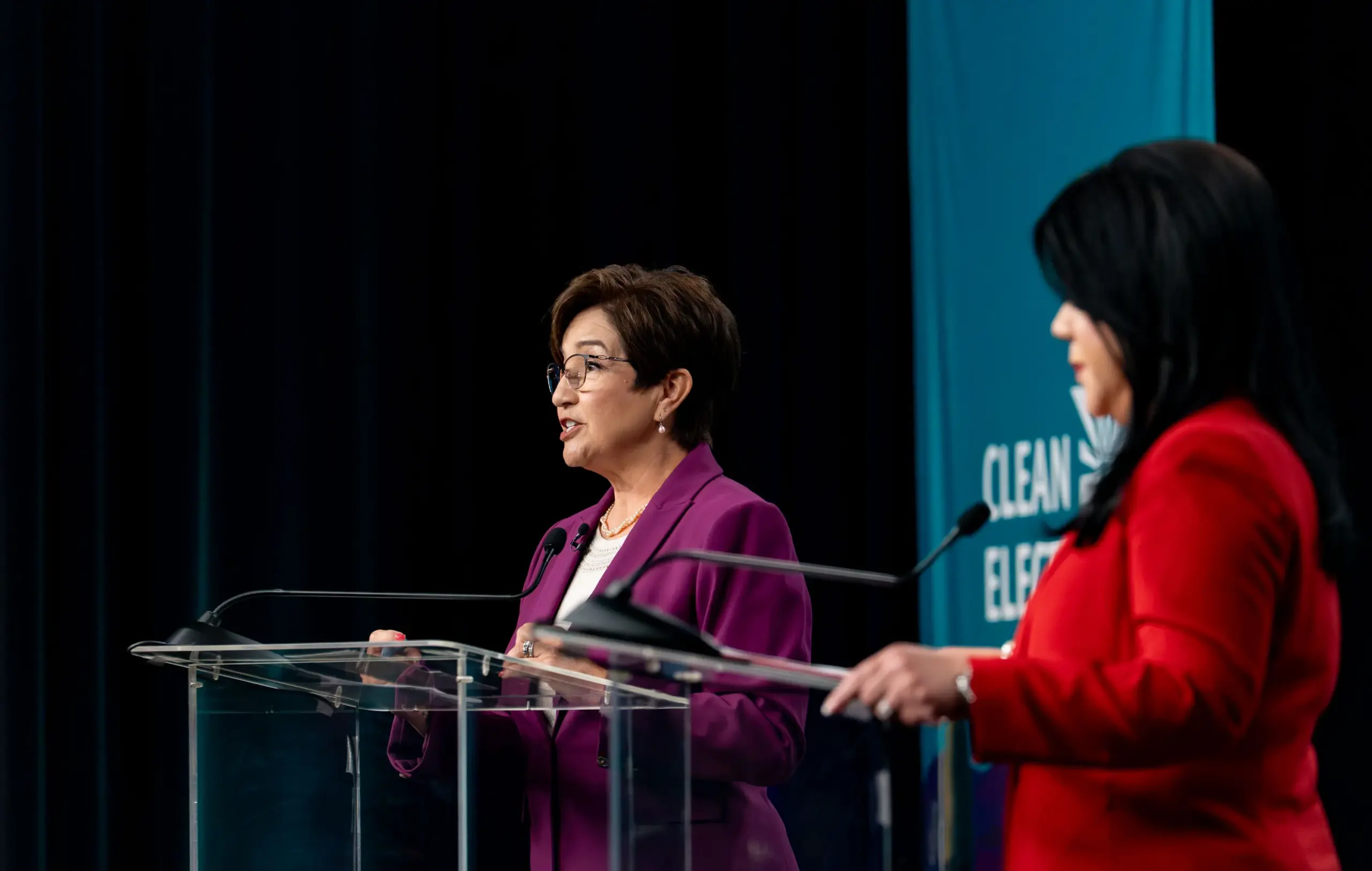
This November may no longer be a referendum on ESA’s — at least directly — but surrogates for each side of the issue are running for the state’s Superintendent of Public Instruction, which oversees the program. On Tuesday evening, the two candidates, Democrat and longtime educator Teresa Leyba Ruiz and Republican state Treasurer Kimberly Yee, made it clear that the issue is still on the ballot by proxy. Both women called for the end of the under $2,000 automatic processing policy, but that’s about as far as Yee’s proposals went. Leyba Ruiz called for deeper reforms.
Yee championed the state’s ESA program since its early days. As a state legislator, she sponsored the state’s original ESA legislation in 2011. In early 2025, flanked by far-right Republican legislator Jake Hoffman, Yee announced that she’d be primaring the current superintendent, Republican Tom Horne. During the announcement, she argued that Horne went too far and that there should be no limits on parental purchases. Horne didn’t have the power to implement the $2,000 automatic threshold; only the state legislature did, she argued. In July, Yee beat Horne in the primary with 53% of the vote.
During the debate, Yee said the ESA system needs “accountability” and proposed a “financial platform to get to a better accountable system for the taxpayers in Arizona.” Acting as the GOP-backed school voice surrogate, she downplayed the program’s misspending and pushed back against the notion that the state should ensure ESA students meet certain academic standards. She said — seemingly without evidence — that such oversight would violate HIPAA and FERPA.
The school voucher program has been mired in controversy since it became universal in 2022. Earlier this year, the Arizona Auditor General’s Office found that nearly 2.3 million transactions under $2,000, totaling more than $653 million, were processed automatically through a program policy. Of that, only 6.5% of ESA purchases were actually audited. Reporting has revealed inappropriate purchases of diamond necklaces, iPhones, widescreen TVs and Kenmore appliances.
In June, the wonks in the education policy geared up for a referendum on the program during the November election. Public education advocates, including the teachers’ union, gathered signatures to get a citizen-led ballot measure in front of voters to place guardrails on the program. Republican lawmakers advanced two ballot propositions that aimed at curtailing teachers’ unions and protecting the state’s voucher program by safeguarding military families’ ESA funds, while also serving as a poison pill for the citizen-led measure.
All three measures were challenged in the courts. And all three were knocked off the ballot.
The Arizona Supreme Court found that advocates didn’t gather enough signatures to qualify. A lower court found that the two GOP-backed propositions were too broad. They touched on multiple issues, which Arizona law doesn’t allow. The Arizona Supreme Court upheld that decision.
Read more Congrats Arizonans! You rank last in cussing, study finds
Unsurprisingly, Leyba Ruiz, acting as the public education advocate surrogate, criticized the ESA program and called for reforms during her time. She began her career as a 7th-grade math teacher before teaching high school and moving to higher education at Arizona’s community colleges. In 2023, she retired as the President of Glendale Community College. If elected, she said she’d create a “transparency portal” to let taxpayers know where tax dollars are being spent and called for an independent third-party audit. She called for background checks for private educators receiving ESA dollars and academic process check-ins to “know if our children are safe.”
“It’s written to be exploited, and we see that’s happening,” she said. “It’s hard to imagine that there’s a billion dollars a year being spent on expanding the ESA program when our public schools are last in the nation.”
Leyba Ruiz also attributed school closures — which have rocked Arizona schools in recent years — in part to the ESA’s universal expansion, which has “drained resources away.”
“Arizona cannot be last in the nation,” she said. “We must invest in our students so that our children have a school that is not struggling around them.”
Despite her public education background, Leyba Ruiz told the press after the debate that she didn’t send her kids to public school, opting for a religious private school. She didn’t use ESA funds, but when a reporter questioned her on that decision, pointing out that other Arizona families wouldn’t have the same option, she shot back.
“Because we worked hard for it?” before adding that, “the current ESA value does not come close to touching private school tuition.” Yee declined to answer when asked the same question.
Read more Judge rejects Maricopa County’s bid to end racial profiling reforms