
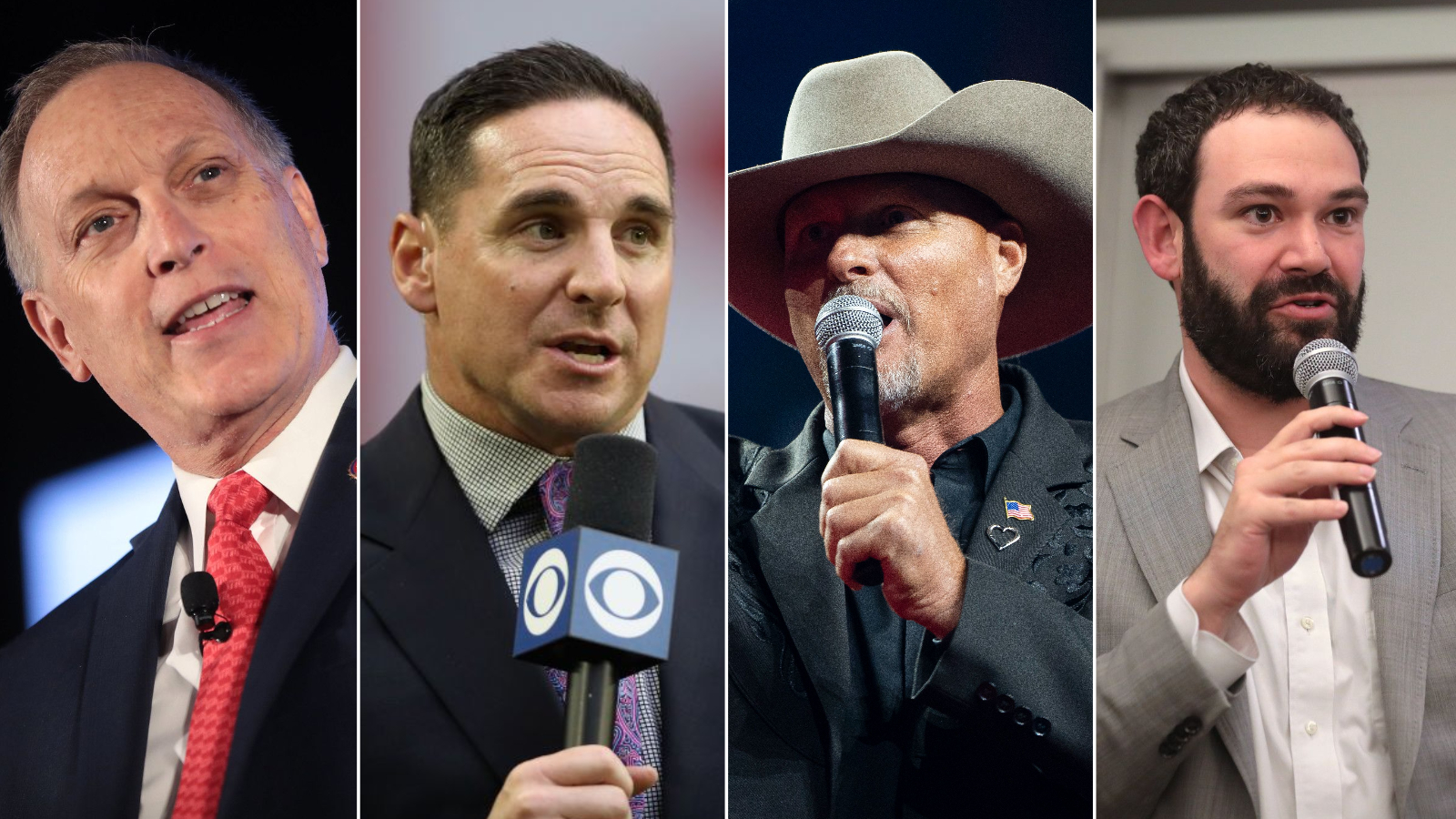
Early results are in from Arizona’s July 21 primary election, and already several major races have been decided.
Read more Valley measles outbreak grows: Where you may have been exposed
Trump-endorsed Republicans won their contests in a number of races, setting up general election showdowns that should offer voters stark contrasts. In November, voters will be asked to choose between distinctly MAGA-flavored candidates for governor (Andy Biggs), secretary of state (Alexander Kolodin) and attorney general (Warren Petersen) or Democratic incumbents Katie Hobbs, Adrian Fontes and Kris Mayes. As GOP political consultant Barrett Marson pointed out in a text to Phoenix New Times, it’s a strategy that has failed Arizona Republicans time and time again.
“Just like in 2022, Republicans stuck with MAGA and election deniers. It didn’t work four years ago,” Marson wrote. “I guess the voters either figured second time’s a charm or they actually like Hobbs/Fontes/Mayes as officeholders and wanted to give them the easiest candidates to beat.”
Election results will continue to trickle in over the next few days — counting ballots takes time, folks — but here’s what we can say so far about the 2026 primary.
Biggs wins big in governor race
Just three minutes after the Maricopa County Elections Department released its first batch of results, the Associated Press had already declared Biggs the winner in the GOP gubernatorial primary. The Trump-endorsed and Turning Point-backed congressman boasted 73.4% of votes as of publication.
For anyone paying attention, it wasn’t a surprising result. After Republican businesswoman and lobbyist Karrin Taylor Robson dropped out of the race in February, the field was essentially cleared for the Gilbert-based Biggs to face off against incumbent Democrat Gov. Katie Hobbs in the general election in November. Through the primary, Biggs essentially ignored his biggest opponent, fellow Rep. David Schweikert, who garnered only 14.7% of the vote. Schweikert’s campaign never really got off the ground in terms of fundraising or attention.
Biggs and Hobbs have already pivoted toward the general election. Shortly after the AP called the race for Biggs, Hobbs’ team released a campaign ad titled “Big Problem,” criticizing Biggs’ healthcare-related votes in the House of Representatives, his consumption tax plan and his vote against releasing the Epstein files.
Mark Lamb weathers scandal in CD5
It turns out that getting freaky and convincing friends to sleep with your wife doesn’t raise alarm bells in the conservative bastion of Arizona’s 5th Congressional District. Nor does threatening women with prosecution should they go public with your horned-up ways. Nor, apparently, does possibly living in Tennessee rather than in Arizona.
Former Pinal County Sheriff Mark Lamb has been accused of all of that this election cycle. That didn’t stop Lamb, who enjoyed Trump’s endorsement, from running away with the GOP primary in CD5, which covers parts of Gilbert, Chandler, Queen Creek and San Tan Valley. The AP called the race for Lamb after the first ballot drop Tuesday night, and he led challenger Daniel Keenan with 58.4% of the vote as of publication.
Republicans far outnumber Democrats in the district, which is currently represented by Biggs. That pretty much makes Lamb, who fell short against Kari Lake in the Senate race two years ago, a shoo-in for Congress against likely Democratic challenger Elizabeth Lee.
Jay Feely survives and thrives in CD1
While the race to replace Biggs in Congress wasn’t all that dramatic, the battle for Schweikert’s seat in Arizona’s 1st Congressional District has been ugly at times. In the end, former NFL kicker Jay Feely survived a spirited — and sometimes racist — challenge from far-right former state Rep. Joseph Chaplik. The AP declared Feely the winner not long after polls closed; as of publication, Feely had 49.7% of the vote to Chaplik’s 35.6%.
Feely had the stronger backing all along, with support from national Republican groups and an endorsement from Trump. (The latter was a bit ironic, given that Chaplik was by far the Trumpier candidate in the race.) Chaplik spent much of the campaign questioning Feely’s MAGA credentials, including by criticizing Feely for deigning to help a few Haitians. While Feely sometimes struggled to appeal to Trump’s base while not going full MAGA, his balancing act was apparently good enough for voters in CD1, a wealthy district covering north Phoenix, Paradise Valley and Scottsdale.
It also arguably gives Republicans a better chance of holding onto the seat in November. Like Feely, Schweikert never fully leaned into the MAGA and Turning Point side of the Republican Party, managing to win enough independent voters to stay in office. Chaplik would have had a harder time doing that.
Read more These Arizona lawmakers missed the most work in 2026
Shah’s doorknocking overcomes big D.C. money
No winner has yet been declared in the Democratic primary in CD1, but former state Rep. Amish Shah leads by seven percentage points. The emergency medicine doctor has been engaged in a tense race against former broadcast journalist (and former Republican) Marlene Galán-Woods, who sits in second in the four-way race.
Democrats have focused intently on CD1 in recent years, viewing it as a chance to steal a seat from Republicans. Indeed, the Democratic Congressional Campaign Committee poured money into the race — specifically in support of Galán-Woods. The ex-journalist and widow of former Arizona Attorney General Grant Woods also picked up endorsements from Attorney General Kris Mayes and Sen. Mark Kelly, among other prominent Democrats.
Shah bristled at that thumb being placed on the scale, though it may not ultimately matter. His robust door-knocking campaign might have proved the difference. Should his lead hold, he’ll be set to face Feely in the general election. Shah was also the nominee two years ago, when he lost by four points to Schweikert. The political winds may favor him this time around.
Stanton holds off challenge from the left
So far, 2026 has been the year of progressives in Democratic primaries, with far-left challengers unseating incumbents across the country. Rep. Greg Stanton, the former Phoenix mayor who represents parts of Phoenix, Chandler and Tempe, won’t be one of them.
Despite facing a primary challenge from Kai Newkirk in Arizona’s 4th Congressional District, Stanton has cruised to victory. The AP called the race for Stanton after the first batch of results. With 96% of the estimated vote counted as of publication, he’s garnered 65% of the vote.
In a statement, Stanton thanked voters, his team and volunteers, and also Newkirk and his supporters for the “passion and energy they brought to this race.“ On social media, Newkirk wrote that he had called Stanton to concede and pledged to support Stanton in the general election. Stanton is expected to sail to victory against Republican religious commentator Zuhdi Jasser in November.
Turning Point slate sails to victory
Turning Point-backed candidates may not fare well in general elections, but primaries are a different story. In several statewide GOP primary races, the Turning Point choice won handily.
Former Arizona GOP chair Gina Swoboda has a strong relationship with Trump, who gave her a kinda-sorta endorsement in her race for secretary of state a few weeks ago. But Turning Point-backed state Rep. Alexander Kolodin, who made his name as an attorney attempting to overturn the 2020 election, was declared the winner by the AP shortly after the first batch of results dropped. Kolodin had more than 59.6% of the vote as of publication. Though Swoboda has not been sparing in her disdain for Kolodin, she said on social media that she wishes “our party nothing but success up and down the ticket in the General Election.”
Similarly, incumbent Superintendent of Public Instruction Tom Horne looks poised to lose to Turning Point-backed challenger Kimberly Yee, the current state treasurer. Yee, who was recruited to run against Horne by far-right state Sen. Jake Hoffman, led Horne with nearly 53% of the votes as of publication. Apparently, persistently attacking Horne from the right and painting him as a threat to the state’s school voucher program — a comical suggestion, given how little Horne has done to rein it in — was a winning strategy. In November, Yee will face Democratic candidate and former community college administrator Teresa Leyba Ruiz, who cruised to an easy victory Tuesday.
The GOP race for attorney general is also decided, though it doesn’t quite fit under the Turning Point umbrella. Neither candidate — Arizona Senate President Warren Petersen and former Democrat Rodney Glassman — was endorsed by Turning Point, though Glassman got the same almost-endorsement from Trump that Swoboda received. The two men slung a lot of mud at each other throughout the campaign, but Republican voters apparently preferred what Petersen was flinging. On Tuesday night, Decision Desk HQ called the race for Petersen, who had nearly 56.2% of the vote as of publication. He’ll face Democratic incumbent Kris Mayes in the general election.
Notable Arizona Legislature results
Very few races for the Arizona Legislature were actually contested, as both major parties tend to line up their primary slates ahead of time. But early voting tallies produced a few interesting results.
Perhaps most notably, Democratic state Rep. Lydia Hernandez looks destined to lose her West Valley-based seat in Legislative District 24. Hernandez, who has angered fellow Democrats with her votes, was targeted for a primary challenge by state Sen. Analise Ortiz’s No Safe Seats movement. Early results had Hernandez and Rosa Cantu, who serves on the Cartwright Elementary School Board with Hernandez, significantly trailing progressive challengers Alberto Flores and Lisbeth Arescurenaga.
Read more Hire Full-Service Movers Across The USA
Other state legislature results worth noting:
- In another win for progressives, state Sen. Lauren Kuby looks likely to cruise to an easy victory over challenger Deborah Nardozzi in Tempe-based Legislative District 8.
- On the other hand, incumbent Tucson state Rep. Alma Hernandez had a roughly 1,280-vote lead over progressive challenger Roque Perez in one of the state’s most hotly contested legislative primaries.
- Anthony Kern, the far-right former state senator, fake elector and Jan. 6 participant, was 327 votes behind incumbent GOP state Sen. Kevin Payne in Legislative District 27, which covers some of the northwest Valley. Kern gave up the seat two years ago to make an ill-advised run for Congress.
- James Rogers is likely headed to the Arizona House of Representatives with a comfortable lead for the second of two seats in Legislative District 10, a conservative stronghold. A lawyer with the Stephen Miller-founded American First Legal, Rogers has represented Maricopa County Recorder Justin Heap in his battle against the Republican-controlled county board of supervisors, some of whom have claimed Rogers has essentially taken control of the recorder’s office.
- Heather Rooks, a MAGA devotee and current Peoria Unified School District member who has gotten in trouble for praying at board meetings, fell flat in her attempt to win a nomination for the House in Legislative District 28. She significantly trails Beverly Pingerelli and David Livingston, the two incumbents.
Other primary election odds and ends
- Amusingly, given that he outraised her by more than $2 million, former ASU quarterback and Valley businessman Hugh Lytle was trailing fellow No Labels candidate Teri Ann Hourihan for the party’s nomination for governor. As of publication, Hourihan had a 1,038-vote lead and was leading Lytle by 11 points. Campaign finance records show Lytle brought in more than $2.1 million this cycle and spent more than $900,000 on the race, while Hourihan raised just shy of $30,000 and spent most of it.
- The Arizona Green Party has been in a tizzy about governor candidate Risa Lombardo and secretary of state candidate Duwayne Collier, both of whom appear to be sham candidates put up by Republican interests. But if the Green Party’s write-in campaign to thwart them has had any effectiveness, it hasn’t shown up in early results. Statewide results on the Secretary of State website show Lombardo and Collier having received every vote so far. Maricopa County’s election results show them with mere majorities, though without any write-in candidates listed at all. Then again, we’re talking about a minuscule number of votes, and it’s possible the write-ins will be reflected in later updates.
- Democrat Matt Orlando, a current Chandler City Councilmember, has a huge lead in the race for Chandler mayor over current GOP state Rep. Jeff Weninger, who decided not to run for reelection in order to try for the mayorship. Orlando has 58.3% of the vote as of publication.