
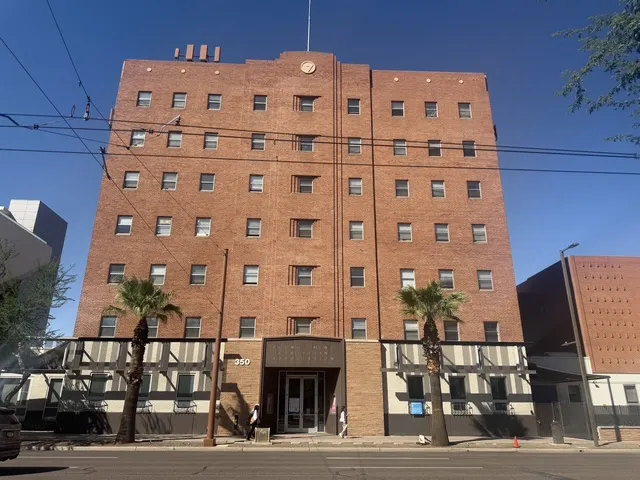
Deon Gilchrist mostly kept to himself in his transitional housing dorm at the Lincoln Family Downtown YMCA. He said he paid his $600 monthly rent, listened to the staff, followed the rules, and didn’t make a fuss.
Read more More than 3,000 voters in Maricopa County got this year’s ballot early
That is, until he received an email on Aug. 7 that said the downtown “Y”’s housing program would be shut down on Sept. 30, with an eviction date set for the following day.
“It would have been nice to give us a heads up,” Gilchrist said. “I probably would have been able to kind of save up some money. But they didn’t. They waited ‘till August 7.”
The Lincoln Family Downtown YMCA closed on Sept. 30, by which point most residents, including Gilchrist, had found new places to live. The remaining few were permitted to stay at the “Y” as they worked with case managers to find housing.
On Friday at noon, the time originally believed to be the official eviction date, Gilchrist and organizers from the Valley Tenants Union stood outside the downtown “Y” in protest.
The event was largely symbolic, as no residents were forced to exit the premises at that time.
The most dramatic scene unfolded when organizers tried to hang a banner reading “YMCA makes millions by putting tenants in homeless shelters” from the downstairs windows, and a security officer emerged from behind a locked gate and told them to take it down, or he would call the police.
After removing the banner, organizers held it up themselves for about an hour as passersby, including Arizona State University students, businesspeople and other assorted Phoenicians, walked along the cramped sidewalk.
Ari Smith and Paris Wickramaratne, union organizers, said they have known the people living in the building for years and are friends. The two characterized the downtown “Y”’s treatment as a lack of dignity shown to the tenants.
Smith and Wickramaratne, unpaid union volunteers, said they helped residents move, carting mattresses and personal effects as far as Peoria.
“We are spending our time doing the things that the people with the money could do and don’t,” Wickramaratne said.
The union, which Wickramaratne said does not speak for tenants but rather gathers them and documents information they share, put together a list of five demands the residents of the “Y” shared with them.
The demands included no evictions until every resident was placed in permanent housing with comparable rent, financial support for moving and startup rent costs, extending the housing program until January 2027, refunding rent paid in 2026, and canceling September rent.
Smith said the union sent the demands to the building’s management and concluded the message with Bible verse Proverbs 21:13, “Whoever shuts their ears to the cry of the poor will also cry out and not be answered.”
Since the initial Aug. 7 email notice, most of the residents were able to move out and find new housing, with caseworkers helping along the way.
Deon Gilchrist loves living in the city.
Other than a short stint in a small town in Ohio, Gilchrist has spent his life in busy metropolitan areas, from Los Angeles to Las Vegas to now, Phoenix.
Read more Rival cities are not green with envy at the findings in this report
“I’m from the city,” he said. “That’s where I should be at, living in the city.”
In his 20s, he said he had no direction. He had watched his parents engage in criminal activity and drug use, and at that point he said he was charged with burglary, got caught up in drugs and alcohol, and was homeless.
“I couldn’t escape it, you know,” Gilchrist said. “But I knew that in my heart that wasn’t the life I wanted. It was something that I wanted to do at the time, but my life kept spiraling out of control.”
He said his life changed 14 years ago, on Dec. 30, 2011, when he got sober.
After getting clean at a rehab facility, he entered a single-room occupancy program with his own room, fridge, and bathroom.
“It was the first time in my adult life that I was able to be responsible,” he said.
Gilchrist moved out to Phoenix in 2019, needing a change from the fast-paced Los Angeles lifestyle. He said he would take Arizona over Los Angeles any day.
After losing his job and falling on hard times, Gilchrist ended up at a halfway house in 2024. With the downtown “Y” closing its doors, he had to move back to that same halfway house.
“I didn’t want them to have the luxury of kicking me out prior to September 31,” he said.
While it is not the private space he had a few weeks ago, his halfway house is in a new area, and he said it’s a lot better than it used to be. The house has a cook, a full pantry, and helped him get a job in the area that he had to report to at 2:30 on Friday afternoon.
Not all residents had that same experience, though. Smith said union members will likely be sleeping in their cars or outside tonight because they have nowhere else to go.
“People shouldn’t be on the streets, people should not be homeless, people should not be in shelters,” Gilchrist said. “We should be working, having a job.”
That wasn’t the case early Monday morning after the formal eviction process. Across the street from the newly deserted “Y,” with posterboard demolition-request notifications lashed to the downstairs windows, a man lay crumpled in a small patch of shadow.
He was motionless. He remained indifferent to the flies that landed on the splotches of open wounds that covered his hands and face. A homeless man walked past and asked aloud, “Is he alive? Is he breathing?”
For a moment, the answer was unclear. After a few beats, the passerby jabbed the motionless man with his foot. The man finally roused and craned his head around, bewildered.
“Alright, he’s alive,” the passerby said, relieved. “Thank God. That’s the second guy I passed this morning who I thought was dead.”
Read more Phoenix home prices have outpaced inflation by 177%, study finds