
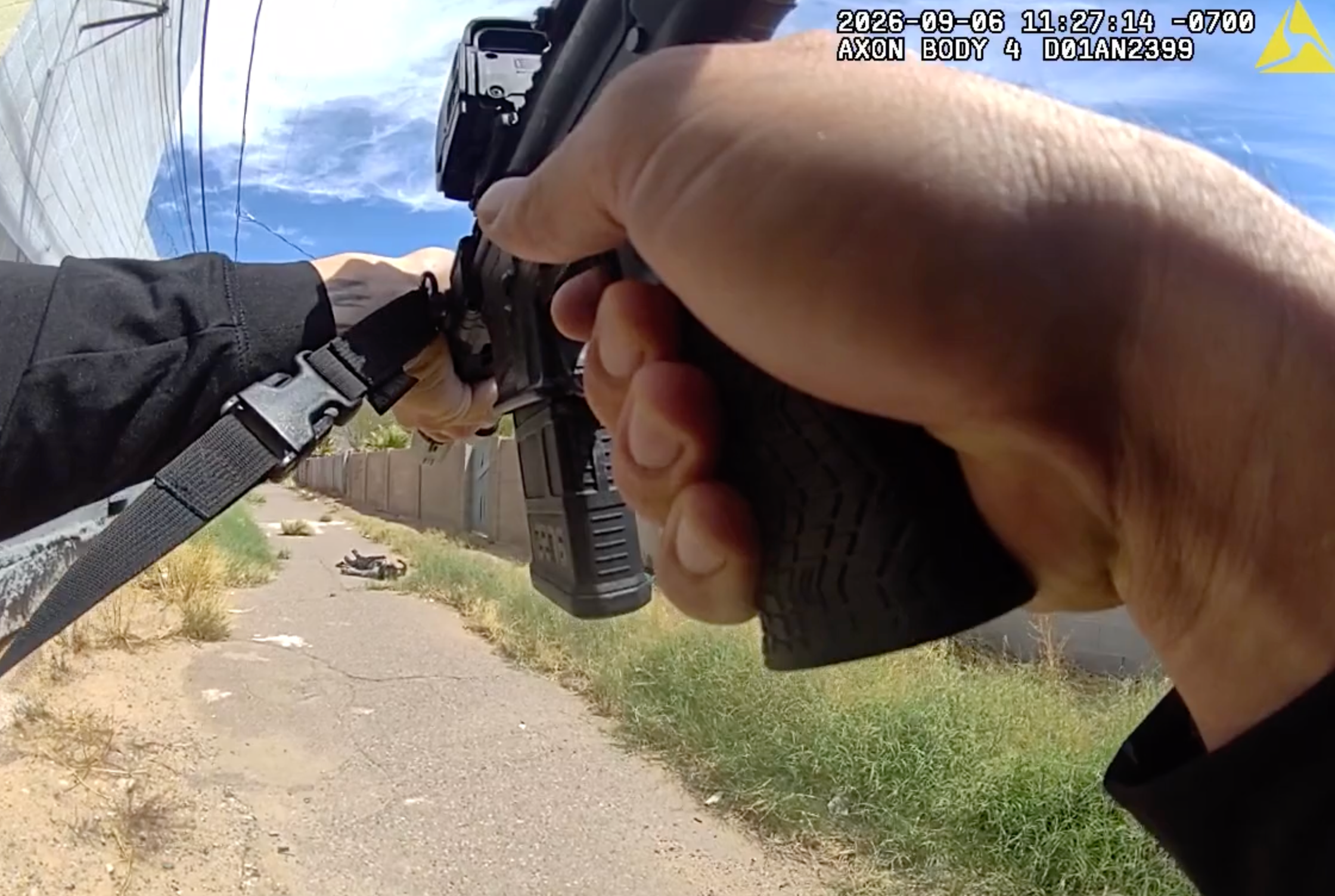
On the morning of Sept. 6, two Phoenix police officers shot and killed 20-year-old Jonathan Marquez Delgado. The officers killed him while responding to a 911 call from his family member that he had a knife and was going to hurt himself, the Phoenix Police Department said.
Read more Violence against women and trans people is worse than you thought
On Friday, the Phoenix Police Department released its “critical incident briefing” on the shooting. The briefing consists of a video and an accompanying write-up, and includes 911 call audio, a photo of the knife and footage from two officers’ body-worn cameras. The department releases the briefings approximately two weeks after a critical incident, which includes a fatal shooting by an officer.
Phoenix New Times received longer versions of the body-cam footage and 911 call through a public records request. The approximately 30 minutes of footage and seven-minute-long 911 call paint a fuller picture of what happened in the alley near 1800 West Cheryl Drive that day.
The shooting
The 911 caller was desperate. Her nephew, Delgado, was in the alley with a knife. He was calm, she said to the dispatcher, and not trying to hurt her.
“He’s mainly trying to hurt himself,” she said, crying into the phone. “We could calm him down. I think he’s just mentally ill.”
It looked like he’d cut his neck. He needed medical and mental health care. The dispatcher got the Phoenix Fire Department on the line. They asked her questions. The aunt said she couldn’t see him. The alley was locked. He’d cut his own neck with what might be a kitchen knife. He had no other weapons.
“Jonathan, please! We could talk, baby!” she yelled to her nephew. “My God, my heart,” she sobbed. “Police are here.”
Officer Michael Ugalde-Flores arrived first. He climbed out of his patrol Tahoe and asked the aunt where Delgado was. She pointed to an alley with a closed black iron gate.
“I saw him jump,” she replied, her voice wavering. “He’s missing a shoe.”
Ugalde-Flores approached the gate. He pressed his face against it and peered through. He spotted Delgado laying in the distance.
“I can see a male lying down. Just his head bops up,” Ugalde-Flores reported over the radio, while another officer tried to open the gate. He asked the aunt if Delgado was under the influence. No, she responded. He’s mentally ill but doesn’t have a diagnosis because he doesn’t have ACCCHS, the aunt explained.
“He hasn’t been able to get mental health,” she said. “We were able to talk him down yesterday.”
The gate opened. The officers entered.
“Is he the one screaming,” Ugalde-Flores asked the officer who got the gate open.
“Yeah, I think so,” the officer responded.
Two more family members joined at the gate’s threshold. They offered to help. Ugalde-Flores explained that they needed to get the knife first.
“I talked him out of it yesterday,” a family member said. “Let me talk to him.”
“Don’t make it worse,” the other family member added.
Ugalde-Flores asked them if Delgado had ever been arrested and about his attitude toward law enforcement. They didn’t know. Ugalde-Flores told the family that they would approach Delgado and see how he reacts.
“If you can’t do it, let me do it,” the first male family member said.
“If we need you, I’ll bring you in, OK?” Ugalde-Flores replied.
The four officers approached Delgado.
“He didn’t threaten anyone, did he?” Officer Gerrit Groenewold asked, weapons pointed down at the ground.
“No, just himself — is he cutting himself?” Ugalde-Flores said. “Did he just cut his neck?”
“I see red all over,” Groenewold said.
They jogged towards Delgado as he lay on the ground, grunting and yelling. They decided to use a Taser 10 on him first. It made a high-pitched sound as the officer powered it up. They commanded Delgado to drop the knife. He stood holding it. He walked backwards away from the advancing officers.
“Shoot me!” he yelled at them. “Shoot me!”
The officers approached, now with their weapons raised. Ugalde-Flores, who had his handgun trained on Delgado, cautioned the group to slow down. They yelled at him to drop the knife. Delgado retreated, knife in hand.
Read more Arizona’s rival universities tie in 2027 U.S. News & World rankings
“You guys are not going to shoot me?” he yelled.
“We’re just here to help you,” Ugalde-Flores yelled back.
“I fucked up. Just shoot me already,” Delgado shouted.
Ugalde-Flores pleaded with him to drop the knife. They were there to help.
“Just drop it, you’ve got family here!” he yelled. “I promise you’re not in trouble, just drop it.”
Meanwhile, Delgado shouted at them to shoot him.
The officer deployed the Taser. It failed. Delgado sprinted towards them. Ugalde-Flores fired his handgun, Groenewald his rifle. Delgado crumpled to the ground. The encounter, from when officers started walking towards Delgado in the alley to when they shot, lasted just over two minutes.
The aftermath
Someone shrieked. It filled the alleyway. Delgado lay on his back after the officers shot him. The knife fell from his hand when he collapsed. He grabbed at it one more time before it slipped out. Then he was still. The officers moved towards him when his left arm moved again slightly.
“Don’t grab the knife,” Ugalde-Flores yelled at Delgado, who was twitching. “We’re going to get you help.”
Ugalde-Flores and Groenewald approached him together. Groenewald kicked the knife away. Ugalde-Flores grabbed Delgado’s arm.
“I’m not even going to cuff him,” Ugalde-Flores said while he held Delgado’s left arm and rolled him onto his side. “He stabbed himself a lot.”
Delgado’s long-sleeve green shirt was stained around the neck with blood as if he’d sweated through it. A patch of blood bloomed on his back; it smeared the pavement. Groenewald cut off Delgado’s shirt, revealing a self-inflicted knife slash on his abdomen. He snipped off Delgado’s pants so they could account for his wounds. He repurposed the shirt strips and held them to his neck to apply pressure. Delgado laid still in his black underwear covered with blood. He had two gunshot wounds to the chest, the spot where officers need to do compressions. Ugalde-Flores radioed for someone to get chest seals from his patrol vehicle. Then, the officers fell silent. They assessed the limp body.
“Fuck it. We can just try chest compressions,” said Ugalde-Flores. Groenewald started to apply compressions, counting under his breath. Sirens from the fire department grew closer. A neighbor came out to see what was going on.
“We heard gun shots,” the neighbor said.
“That’s us,” an officer replied.
Ugalde-Flores swapped in. He did the chest compressions. Groenewald held the shirt against Delgado’s neck wound.
They performed chest compressions for about three minutes while they waited for the fire department. They counted the shots with the newly arrived first responders: “One, two, three, four, arm five,” said Ugalde-Flores.
What’s next
Delgado was the ninth person shot and killed by Phoenix police this year. Phoenix cops killed three people within a few days of each other in March.
The department killed 11 people last year, down from the previous two years. That’s significantly down from a high in 2018, when Phoenix cops killed nearly twice as many people, the most by any department in the country that year. However, 11 shooting deaths is still higher than many similarly-sized departments.
Ugalde-Flores has been with the department for five years. This is his second officer-involved shooting. In May 2025, he shot a man who attacked him during a traffic stop and tried to take his gun. The man, , survived and was sentenced to five years in prison this past spring for aggravated assault on a first responder. Ugalde-Flores appears 22 times in the department’s online use of force databases for incidents dating back to September 2022, including for shooting Perone. The department found all of the incidents to be within policy.
Groenewald has been with the department for seven years. He appeared three times in the database. The department found all three incidents, which occurred in 2025, to be within policy.
The department did not release the names of the other officers on the scene. In the critical incident release it said that a Crisis Intervention Team certified officer was there. CIT certified officers are trained to interact with people experiencing mental illness. Public affairs bureau commander Mercedes Fortune confirmed that the officer who fired the Taser 10 was the CIT certified officer.
The shooting is being investigated by the Major Incidents Division of the Arizona Department of Public Safety. The Maricopa County Attorney’s Office will ultimately decide whether criminal charges are brought against the officers.
It’s also subject to an internal review by the Phoenix Police Department. Phoenix police’s policy on the use of deadly force says it is justified only when a “suspect is acting or threatening to cause death or serious physical injury to the employee or others,” and has the opportunity and “the means or instrumentalities to do so.” It also requires that de-escalation tactics “have been tried, have failed, or are determined to have not been feasible,” and that suspects be given “a reasonable opportunity to comply voluntarily.”
Read more The Fine Print Below “Democrats for Biggs”
Have information about this story? Reach Clarissa Sosin on Signal at @csosin.27