
Eighteen-year-old Jane Doe walked into a crowded off-campus fraternity house party in Tempe’s Meyer Park on a Wednesday evening. A brother immediately handed her a cup of wine.
Read more As local governments rethink surveillance tech, advocates worry about where it’s still used
Doe worked as a server in the college town. She was excited to go to the “Wine Wednesday” themed rush party with her friends. But within a few hours, that nervous energy would turn to terror. Doe struggled to stand after hours of fraternity members feeding her and her friends bagged wine, including directly into their mouths. She began to sway throughout the party as she struggled to walk straight. Her eyes were bloodshot. Her speech became slurred.
A fraternity member who lived in the six-bedroom home attempted to put the moves on Doe. She dismissed him, but her inability to control her own body worsened. The 20-year-old fraternity brother tried again and began kissing the nearly blacked-out girl.
One of her friends rushed over to stop him, but before she could, he dragged the 4’11”, 100-pound girl into one of the home’s three bathrooms. He locked the door and put his hand around her neck. He forced his penis inside her vagina and ejaculated inside her, as well as on her lower body.
He exited the bathroom with her clothing and barricaded himself in his bedroom. A friend of Doe’s saw other fraternity members break into the barricaded room and kick the member out of the house. None of the members called police or paramedics.
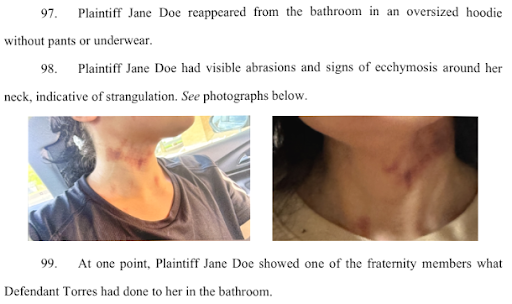
Doe emerged from the bathroom in an oversized hoodie. She was not wearing pants or underwear. Partygoers saw abrasions around her neck. Another fraternity member took off his pants and gave them to Doe.
A friend of hers called an ambulance. Doe got in and was taken to the hospital. A nurse took her blood and conducted a rape kit. Doe’s alcohol concentration was .222% – nearly three times the legal limit. The nurse found semen protein in her genitals and an enzyme produced by saliva on her breast, neck and genitals.
That’s all according to a lawsuit filed in Maricopa County Superior Court late last month. Doe and her family filed the suit against the RHO Chapter of the Kappa Sigma Fraternity at Arizona State University, the national chapter and its endowment fund, as well as the alleged rapist and other fraternity members. The lawsuit alleges that the defendants’ “mismanagement, abuse and unlawful distribution of alcohol,” coupled with the lack of any party oversight, directly led to the violent encounter in August 2024.
“These defendants will not elude responsibility for the harm caused to our client,” Pat McGroder IV, the family’s attorney, wrote in a statement to Phoenix New Times. “Fraternities that benefit from their local chapters and activities must also accept responsibility when those activities have devastating consequences, like they have for this young woman and her family.”
New Times isn’t using the girl’s name at the request of her attorneys. Her name was made public in the initial complaint filing, but the state judge, Greg Como, has since accepted the plaintiff’s request to proceed using a pseudonym. In his Sept. 11 ruling, Como ordered the girl to be referred to as “Jane Doe,” as her “need for anonymity outweighs prejudice to defendants, if any, and the public’s interest in knowing the plaintiffs’ identities.” Her name has since been removed from court filings.
Doe’s “dangerously high blood alcohol concentration was a testament to her severe impairment and inability to consent,” the lawsuit reads. “All Defendants should have known underage intoxicated female guests at the ‘Wine Wednesday’ rush event would be placed in a position of danger to be targeted, isolated, and injured.”
She suffered serious injuries, setbacks in school and mental distress as a result of the assault.
‘No record of the event described’
In an email to New Times, Brad Bailey, the executive director of the Kappa Sigma Fraternity, confirmed that the RHO Chapter at ASU was expelled on October 21, 2024, “along with all of the members on the roster at that time.” He declined to comment further, citing the pending litigation. The lawsuit alleges that the national fraternity forced the RHO Chapter to cease operations after the incident and sent a representative to Tempe to investigate.
The Tempe Police Department confirmed to New Times that it is still investigating the incident but declined to provide more information. The ASU Police Department told New Times it had “no record of the event described.”
In an email to New Times, ASU spokesperson Jerry Gonzalez declined to get into the specifics of the incident, citing ongoing litigation, but wrote that “ASU takes seriously any allegation involving interpersonal violence, including sexual misconduct, by or against any ASU student.”
Read more Suspected killer in gruesome cold case kills himself to avoid charges
He added: “If a student is found responsible for an act of interpersonal violence, including sexual misconduct, they will be held accountable through the student conduct process, which may impose disciplinary sanctions of suspension, expulsion, or degree revocation. ASU may also trespass the student from ASU property.”
Doe’s lawsuit names Tristian Torres as the fraternity member who raped her at the party. Gonzalez confirmed that Torres is “not enrolled at ASU.” Torres’ now-deleted LinkedIn page states he was a business administration student at the university from August 2022 to May 2026.
In an email to New Times, Evan Tompkins, Torres’ attorney, declined to respond to specific questions about the allegations outlined in the complaint or Torres’ background.
“Mr. Torres is entitled to a full and fair hearing before any claimed allegation is treated as fact,” Tompkins wrote. “Mr. Torres intends to fully contest every allegation through the civil process.”
ASU’s troubled history
This isn’t the first time ASU’s Kappa Sigma chapter got itself in hot water.
ASU suspended the fraternity in October 2020 following a lawsuit regarding its hazing practices. The law firm representing Doe in this case, the Law Firm of Beus O’Connor McGroder, represented the pledge who brought that suit.
“(The firm) has confronted abhorrent fraternity misconduct before,” McGroder wrote to New Times. “In 2018, a young pledge was viciously hazed to near death, which resulted only a temporary suspension for Kappa Sigma at ASU.”
Over the course of three months, more than 55 pledges were forced to consume excessive amounts of alcohol, put hot sauce in their underwear, run three miles and eat M&M’s off of a floor that people had thrown up, urinated or pooped on. Pledges were confined to small, hot sheds and suffered through sleepless nights.
McGroder’s firm also represented the family of 19-year-old Jack Culolias. The ASU fraternity pledge drowned in Tempe Town Lake in 2012 after a night of binge drinking at a Sigma Alpha Epsilon pledge hazing event. Gov. Doug Ducey signed “Jack’s Law” in 2022, which criminalized hazing statewide.
“Arizona is one of the few states to make hazing crimes a felony,” McGroder wrote. “We proudly fought for accountability and change then, and we intend to bring the same determination to this case.”
Like Kappa Sigma, SAE also returned to campus after the suspension, only to be removed again.
In October 2025, ASU suspended SAE, leading the university to remove the fraternity from the Greek Leadership Village. The university initially placed the fraternity on interim suspension in April 2025. A month before the fraternity’s suspension, a student who had a brief relationship with a member sued the fraternity after learning that a non-consensual, sexually explicit video of her was distributed through the fraternity as part of a hazing ritual. That case appears to be ongoing, although it’s been placed on the court’s dismissal calendar.
Three months after SAE’s suspension, two former pledges filed a lawsuit against the chapter and 54 individual members, alleging hazing over a three-month period. The pledges claimed that the SAE brother beat them with wooden paddles, compelled them to buy drugs and alcohol for frat members, forced them to binge drink and consume cocaine, required them to complete rigorous physical exercises and also forced them to eat “extremely spicy cheeseballs” with little water. That ongoing case has a court date in October.
Do you have information related to this story? Reach out to the reporter on Signal at 623-295-9472 or by email at [email protected].
Read more Bitter fight over school vouchers define the race for top educator