
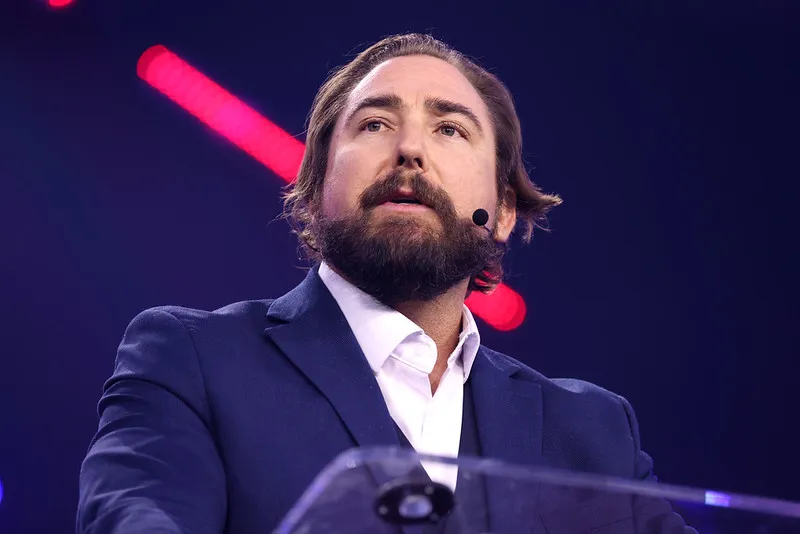
On the first night back after Congress’ August recess, Rep. Thomas Massie, sporting a tan suit and a navy blue tie, stood on the House floor and called on the Department of Justice to investigate and prosecute the “perpetrators” of crimes tied to sex trafficker Jeffrey Epstein.
Read more I guess you could call that a debate
It’s been nine months since December, when the DOJ released the Epstein files, but little has changed. No individuals have been prosecuted in the U.S. in connection with the files. But the Republican Kentucky congressman named names. Twelve in total.
“Jes Staley,” Massie began. “Leon Black. Les Wexner. David Copperfield. Lapo Elkum. Tom Pritzker. Glenn Dudin. Frederic Fekkai.”
That last name, Frederic Fekkai, is a celebrity hairstylist who is accused in a lawsuit of grooming Epstein’s victims to make them look as young as possible. He also engaged in the sexual abuse of these girls himself, according to the lawsuit. In the run-up to the release of the Epstein files — after President Donald Trump was re-elected — Fekkai also made a series of donations to one active congressman: Arizona’s Rep. Eli Crane.
Crane represents Congressional District 2. It covers large chunks of northern Arizona, including the Navajo Nation, Flagstaff and Sedona. It also stretches into parts of Pinal and Maricopa Counties. Crane grew up in Yuma and joined the U.S. Navy, later becoming a Navy SEAL, a week after the September 11 attacks. He co-founded Bottle Breacher, a company that sells bottle openers made from used bullets. In Congress, he’s a member of the far-right Freedom Caucus and sits on the Homeland Security Committee.
In an email to Phoenix New Times, Crane’s chief of staff, Greg Smith, denied that Crane ever met Fekkai or knew his affiliation with Epstein. In response, Smith wrote that Crane donated $2,800, twice the total of Fekkai’s donation, to Destiny House Restoration Center, a non-profit organization focused on combating human trafficking based in Prescott.
It’s unclear why Fekkai donated to Crane. His home state is listed as Connecticut in FEC records. During Crane’s 2024 re-election run, more than 90% of his donations came from outside his district, according to analysis by the Brenna Center for Justice. Fekkai didn’t respond to New Times’ request for comment. His donation to Crane wasn’t a large chunk of cash, but the timing is odd, to say the least.
Fekkai first donated $100 to Crane’s campaign in November 2024, just 21 days after Crane secured a re-election win against former Navajo Nation President Jonathan Nez. Fekkai donated another $100 three days later. Five days later, he slipped another $100 into Crane’s coffers.
The celebrity hairstylist then made monthly $100 donations to Crane’s reelection stockpile from December 2024 to November 2025. In total, the hairstylist donated $1,400 to Crane’s campaign during a non-election year, over an 11-month period.
Read more Video: Phoenix cops shoot, kill suicidal man, 20, in alley with knife
During that period, Democrat Rep. Ro Khanna introduced the Epstein Files Transparency Act in July 2025 to force the release of the files. Two months later, Massie, the Republican architect of the bipartisan effort, tried to force a vote on the House floor through a discharge petition. Crane initially signed onto Massie’s resolution. The effort stalled, and Trump pushed back. Afterward, Crane retreated from Massie’s petition and declined to sign onto the updated resolution.
Fekkai’s monthly donations to Crane continued through this span.
In mid-November — with the swearing-in of Arizona Rep. Adelita Grijalva — legislators finally had the votes to pass the discharge petition. Leaders moved to pass Khanna’s transparency bill. Sensing the writing on the wall, it passed both the House (427-1, with Crane voting “Yes”) and the Senate through unanimous consent. Trump signed it, and a strict 30-day deadline for the DOJ to release all non-exempt Epstein records took effect.
“We are taking an important step toward justice for the victims and consequences for those responsible for these egregious crimes,” Crane wrote in a social media post after the vote. “At the same time, I believe we must protect the privacy of victims and avoid unfairly damaging the reputations of those who did nothing wrong.”
Fekkai’s donations to Crane’s campaign stopped after that. In mid-December, the DOJ released more than 100,000 Epstein-related files. Fekkai’s flagship salon was a top topic of discussion in the release. Fekkai and his salon are referenced more than 3,000 times in the files, according to a lawsuit against Fekkai by seven female Epstein survivors.
In a lawsuit filed in New York’s Supreme Court earlier this month, the women claimed Fekkai’s Manhattan salon was an “epicenter for victim grooming” in Epstein’s network. Fekkai allowed Epstein to use his salons “as a network to manipulate, coerce and commit acts of gender-motivated violence” against young women and girls, the lawsuit claims.
The women alleged that Fekkai enabled Epstein’s sexual abuse for over 15 years. Epstein would frequently bring groups of girls to Fekkai’s Manhattan salon. He’d have them sit on his lap and stroke his hair. Fekkai then groomed the girls to make them look young at Epstein’s direction, which included bleaching their hair blond and making them look like dolls, the lawsuit outlined. One plaintiff said Epstein began victimizing her when she was just 16 years old.
In a statement to New Times, Nez’s campaign spokesperson, Mark Hatton, called Crane’s acceptance of donations from “elites who enabled Epstein’s sexual abuse just days before he voted to conceal” the files “disgusting.”
“This continues a disturbing pattern,” Hatton added, “of Crane protecting the wealthy and powerful instead of standing up to the people of Arizona.”
Read more Violence against women and trans people is worse than you thought